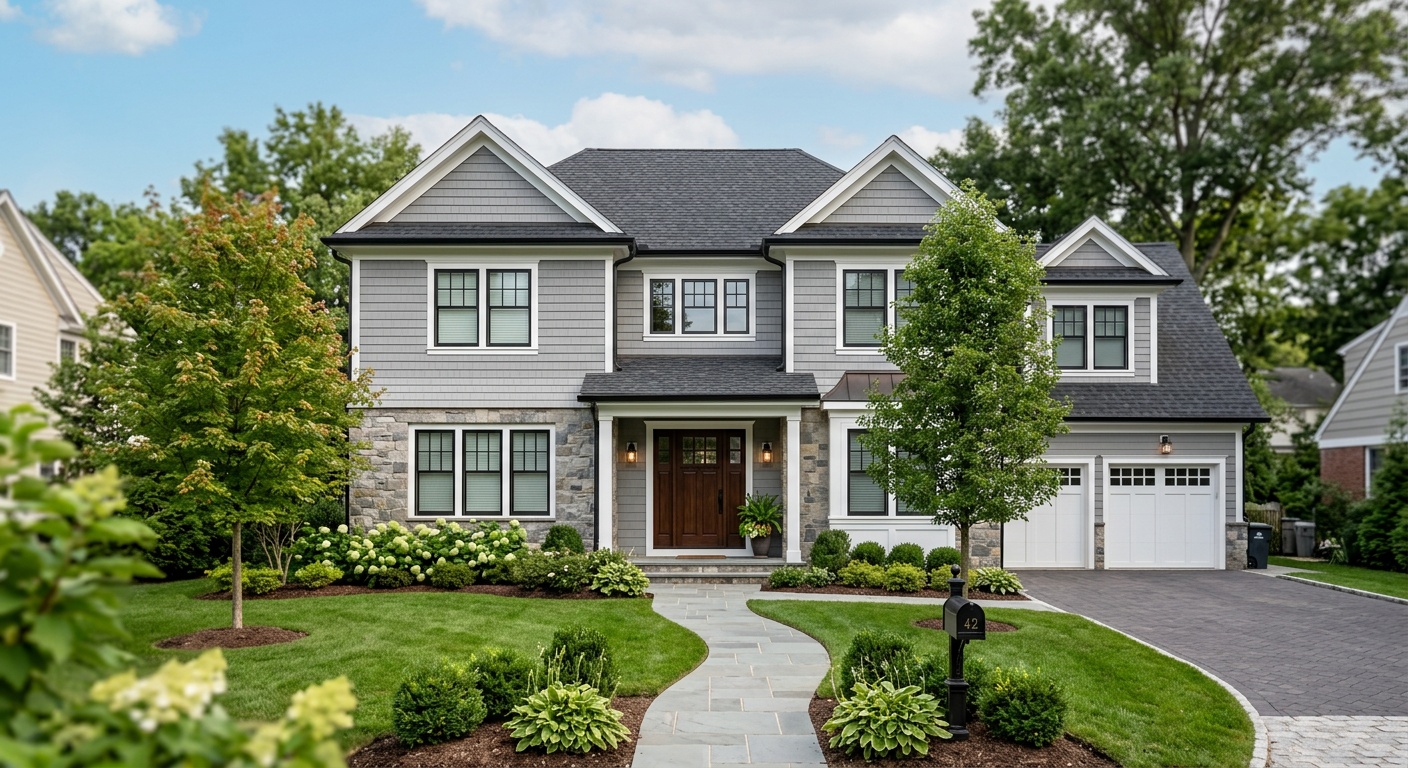
How to Check Your Franktown House Value Online Accurately in 2026
Reading time: 8 minutes
Wondering what your Franktown property is actually worth right now, not what a billboard sign or a hopeful neighbor thinks it’s worth? You’re in good company. With Douglas County’s rural-residential market shifting under the weight of higher rates, limited inventory, and a wave of buyers fleeing denser Denver suburbs, getting an accurate number matters more than ever.
This guide walks you through exactly how to pull a reliable valuation for your Franktown home using free online tools, cross-check it against real comps, and avoid the common traps that make automated estimates wildly inaccurate on large-lot, semi-rural properties like the ones scattered across this pocket of Colorado.
Table of Contents
- Why Franktown Valuations Are Trickier Than Suburban Denver
- Step-by-Step: Getting an Accurate Online Estimate
- Comparing the Major Valuation Tools
- Common Mistakes That Skew Your Number
- When to Bring In a Human Expert
- Your Roadmap Forward
- FAQs
Why Franktown Valuations Are Trickier Than Suburban Denver
Here’s the straight talk: automated valuation models (AVMs) were built for cookie-cutter subdivisions with hundreds of nearly identical homes sold every year. Franktown isn’t that. It’s acreage properties, custom builds, horse setups, and homes on well-and-septic systems rather than city utilities. That combination confuses algorithms designed around square-footage-per-neighborhood averages.
According to Douglas County Assessor data reviewed in early 2026, the median lot size in the Franktown area sits above 5 acres, compared to under a quarter-acre in much of Highlands Ranch or Parker. When comparable sales are scarce and lot characteristics vary wildly, online estimators lean on broader zip-code data—and that’s where accuracy falls apart.
“Rural and semi-rural properties are the hardest category for AVMs to price correctly,” notes a 2025 industry report from a national appraisal trade group, which found automated estimates on acreage homes missed final sale price by an average of 12-18%, nearly triple the error rate seen in dense suburban tracts.
What Makes a Property “Hard to Value” Algorithmically
Three factors consistently trip up online tools in Franktown:
- Well and septic systems — condition and permit status can swing value by tens of thousands, but AVMs rarely factor this in.
- Outbuildings and equestrian features — barns, arenas, and detached shops add real value that public record data often fails to capture.
- Low sales volume — fewer transactions per year means less data for the model to learn from, so it defaults to wider, less precise ranges.
Why Timing Your Check Matters in 2026
Mortgage rates hovering in the mid-6% range through early 2026 have cooled buyer urgency slightly compared to the frenzy of 2021-2022, but inventory in Douglas County’s unincorporated areas remains tight. That means values are still edging upward year-over-year in many pockets, even as national headlines suggest a broader slowdown. Checking your value quarterly, rather than once and forgetting it, gives you a far more realistic sense of where you stand.
Step-by-Step: Getting an Accurate Online Estimate
Quick scenario: imagine you’re planning to refinance or list your Franktown home this spring. Here’s the practical roadmap to get a number you can actually trust.
- Pull three separate AVMs. Check Zillow’s Zestimate, Redfin’s estimate, and Realtor.com’s valuation tool. Write down each number—don’t average them yet.
- Cross-reference the Douglas County Assessor site. Their public records tool shows the assessed value used for property taxes, which typically lags market value but confirms lot size, square footage, and permitted structures.
- Search recent sold comps within 1-2 miles. Use Redfin or Realtor.com’s map-based sold filter, restricting results to the past 6 months and similar acreage.
- Adjust manually for special features. Add estimated value for a finished barn, updated septic system, or newer well pump—items AVMs typically ignore.
- Request a free Comparative Market Analysis (CMA). Most local agents will run this at no cost, and it incorporates local knowledge no algorithm has.
Pro Tip: Treat the online numbers as a starting range, not a final answer. If your three AVMs come back at $850,000, $910,000, and $795,000, that spread itself tells you something—your property likely has unique characteristics that need human eyes.
Comparing the Major Valuation Tools
Not all online estimators are built the same way, and their accuracy varies significantly for rural Colorado properties. Here’s how the major platforms stack up based on user-reported accuracy and data depth for Franktown-area listings in 2026.
| Tool | Typical Accuracy Range | Rural Data Depth | Update Frequency | Cost |
|---|---|---|---|---|
| Zillow Zestimate | ±8-15% | Moderate | Weekly | Free |
| Redfin Estimate | ±6-12% | Good | Daily | Free |
| Realtor.com Estimate | ±9-16% | Moderate | Weekly | Free |
| Douglas County Assessor | Baseline only | High (public record) | Annual/Biennial | Free |
| Local Agent CMA | ±2-5% | Excellent | On request | Free |
Visualizing the Accuracy Gap
The chart below illustrates the average estimation error percentage for each method when applied specifically to acreage properties similar to those in Franktown—lower bars mean tighter accuracy.
Common Mistakes That Skew Your Number
Even savvy homeowners fall into predictable traps when checking values online. Here are the three that come up most often around Franktown.
Mistake #1: Comparing against Parker or Castle Rock listings. These neighboring markets have denser inventory and different buyer pools. A $700,000 home in Castle Rock’s suburbs isn’t a fair comp for five acres off Highway 83.
Mistake #2: Ignoring recent permit history. If you added a detached garage or finished a basement in 2024 or 2025 but never updated county records, every AVM pulling from public data will underestimate your home. Check your county permit portal and make sure improvements are logged.
Mistake #3: Trusting a single snapshot. One Zestimate check in January isn’t a market analysis—it’s a moment in time. Spring 2026 listing activity, expected to pick up as rates stabilize, could shift your number by 5% or more within a single season.
When to Bring In a Human Expert
Online tools are excellent for a quick pulse check, but there are moments when the stakes are high enough to justify a professional opinion. If you’re preparing to sell, refinance, contest a property tax assessment, or settle an estate, a licensed appraiser or experienced local agent should verify the number before you make decisions.
Consider the case of a Franktown homeowner in late 2025 who relied solely on a Zestimate showing $875,000 to set a listing price. After a local agent ran a full CMA incorporating a recently upgraded well system and a 1,200-square-foot barn, the recommended list price came in at $945,000—a difference of $70,000 that the algorithm simply couldn’t see. The home sold within that adjusted range in three weeks.
That’s not a knock on technology—it’s a reminder that online estimates are a starting point, not a verdict.
Your Roadmap Forward
Getting an accurate read on your Franktown home’s value isn’t about finding one magic tool—it’s about triangulating multiple sources and knowing where each one falls short. Here’s your action checklist:
- Pull estimates from at least three AVMs and note the spread between them
- Verify your property details on the Douglas County Assessor site, including recent permits
- Manually adjust for wells, septic upgrades, barns, or acreage features the algorithms miss
- Request a free CMA from a local agent familiar with Franktown’s rural inventory
- Re-check your value every quarter, especially as spring 2026 listing activity increases
As Douglas County’s rural-residential corridor continues attracting buyers priced out of denser suburbs, accurate valuation will only become more important—both for sellers positioning competitively and for owners contesting tax assessments. Your five acres aren’t a statistic in a spreadsheet; they’re a unique asset that deserves a number grounded in real, local evidence.
So before you make your next big financial move, ask yourself: is the number on your screen a genuine reflection of your property, or just an algorithm’s best guess?
FAQs
How accurate is Zillow’s Zestimate for Franktown homes specifically?
Zestimates for acreage properties in areas like Franktown typically carry a wider error margin—often 8-15%—than in dense suburban zip codes, mainly due to limited comparable sales and unique lot features that the algorithm can’t fully assess.
Should I get a professional appraisal instead of using online tools?
For everyday curiosity, online tools are fine. But for selling, refinancing, or tax appeals, a licensed appraisal or agent-prepared CMA is worth the accuracy, especially given how much acreage, wells, and outbuildings can swing your final number.
How often should I check my home’s value if I’m not planning to sell?
Checking quarterly is a reasonable habit. It keeps you informed for insurance purposes, equity planning, and tax assessment reviews without becoming an obsessive daily habit that reacts to minor data noise.
About the Author
